
The theoretical and phenomenological activities of the French community involved in the physics of the EIC are primarily focused on the following two themes: the quark and gluon structure of hadrons, and gluon saturation physics, particularly in heavy nuclei.
Partonic structure of hadrons
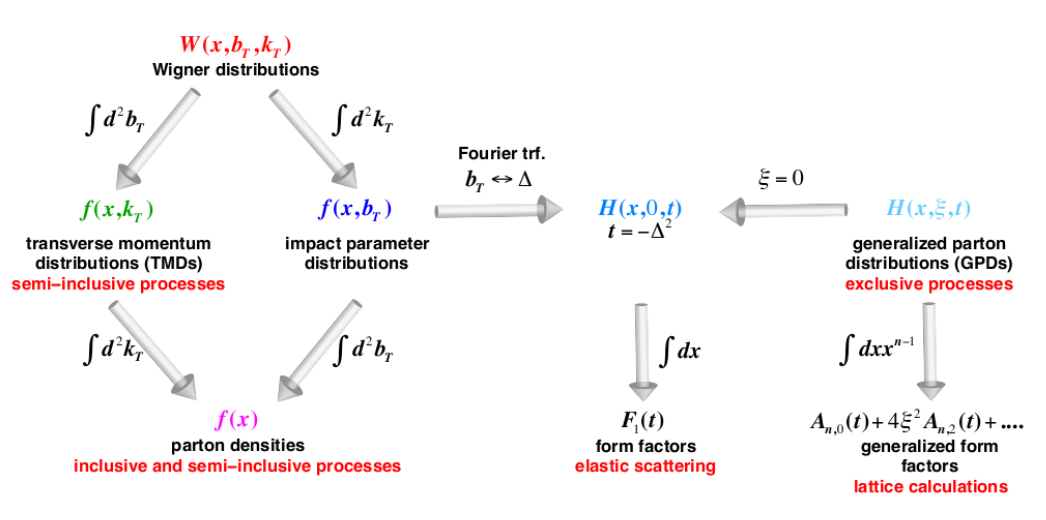
The French community is strongly engaged in the study of the partonic structure (quarks and gluons) of hadrons, primarily protons and neutrons. This includes the three-dimensional tomography of hadrons through the study of transverse-momentum-dependent (TMD) distributions and generalized parton distributions (GPD) and of the origin of the proton spin as a bound state of quarks and gluons. Another research direction concerns the extraction of nuclear parton distribution functions and the study of energy-loss effects in cold nuclear matter.
Transverse momentum dependent parton distribution functions
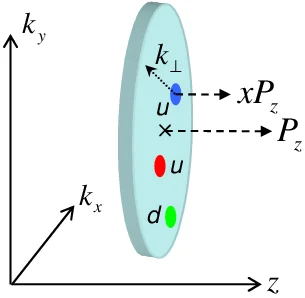


Transverse-momentum-dependent parton distributions (TMDs) encode the nonperturbative distributions of quarks and gluons inside hadrons as functions of both the longitudinal momentum fraction and the transverse momentum of the partons within the hadronic bound state. They can be experimentally accessed through semi-inclusive processes involving two widely separated scales. In particular, at the future Electron-Ion Collider, a key process is the semi-inclusive production of hadrons in the regime where is much larger than the transverse momentum squared of the observed hadron.
- Neural-Network Extraction of Unpolarized Transverse-Momentum-Dependent Distributions, Phys.Rev.Lett. 135 (2025) 2, 021904, arXiv:2502.04166
- One-loop matching for leading-twist generalised transverse-momentum-dependent distributions, JHEP 05 (2025) 183, arXiv:2502.07576
Generalized Parton Distributions and exclusive processes
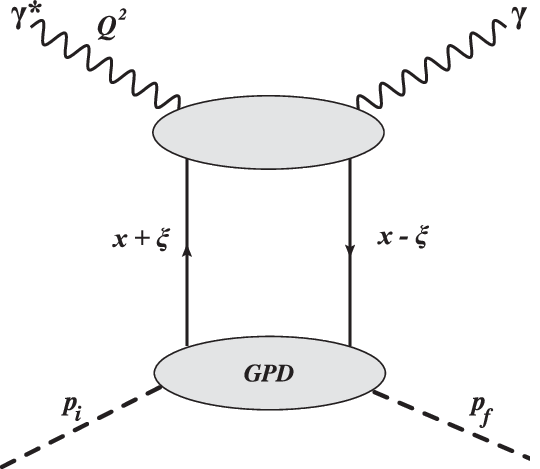
GPDs provide a unified framework for describing the multidimensional structure of hadrons, correlating the spatial and momentum distributions of quarks and gluons. They are accessible through exclusive processes, such as deeply virtual Compton scattering and exclusive meson production, which will constitute a central component of the scientific program of the future Electron-Ion Collider. The French EIC community plays a leading role in the theoretical and phenomenological study of these processes, including the development of factorization frameworks, higher-order QCD calculations, and realistic simulations for future measurements. These efforts aim at extracting GPDs with high precision from experimental data, enabling a three-dimensional tomographic imaging of nucleons and providing crucial insights into the origin of hadron properties, including the decomposition of the proton spin into its quark and gluon contributions.
- Hard exclusive photoproduction of photon-meson pairs: Pseudoscalar channels π, η, and η′, Phys.Rev.D 113 (2026) 3, 034001, arXiv:2511.19720
- Backward DVCS in a Sullivan process, Phys.Rev.D 112 (2025) 3, 034009, arXiv:2504.02657
- Study of deeply virtual Compton scattering at the future electron-ion collider, Phys.Rev.D 112 (2025) 3, 036010, arXiv:2503.05908
Spin and internal structure of the proton
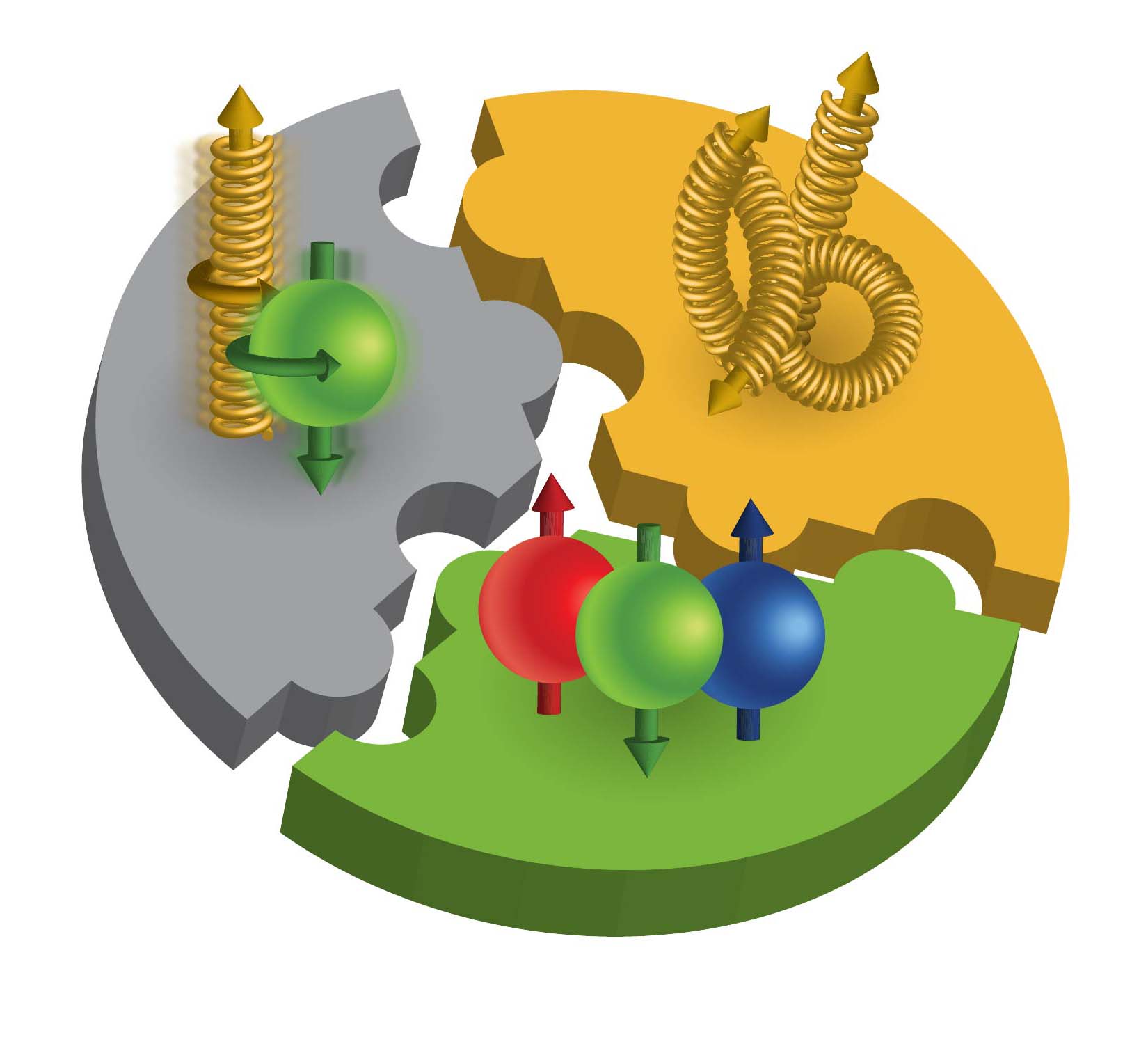
Understanding the emergence of the fundamental properties of the proton from the dynamics of quarks and gluons is one of the central goals of modern Quantum Chromodynamics. Beyond the longstanding proton spin puzzle, key questions concern the origin of the proton mass, the spatial distributions of energy, momentum, and pressure inside the nucleon, and the role played by quark and gluon degrees of freedom in shaping these global properties. The French EIC community contributes to establishing a firm theoretical foundation for these quantities and to connecting them with experimentally accessible observables. The future Electron-Ion Collider will provide unprecedented access to these quantities, enabling precision studies of the spin, mass, and mechanical structure of the proton and offering a unique window into the dynamics that govern the formation of visible matter.
- Constraining the energy-momentum tensor through the DVCS dispersion relation beyond leading power, Phys.Rev.D 113 (2026) 9, 094003, arXiv:2509.06669
- Relativistic energy-momentum tensor distributions in a polarized nucleon, Phys.Rev.D 111 (2025) 9, 094021, arXiv:2503.07382
- Helicity-dependent parton distribution functions at next-to-next-to-leading order accuracy from inclusive and semi-inclusive deep-inelastic scattering data, Phys.Lett.B 865 (2025) 139497, arXiv:2404.04712
- Spin-orbit entanglement in the Color Glass Condensate, Phys.Lett.B 859 (2024) 139134, arXiv:2404.04208
Nuclear PDFs and energy loss in cold nuclear matter
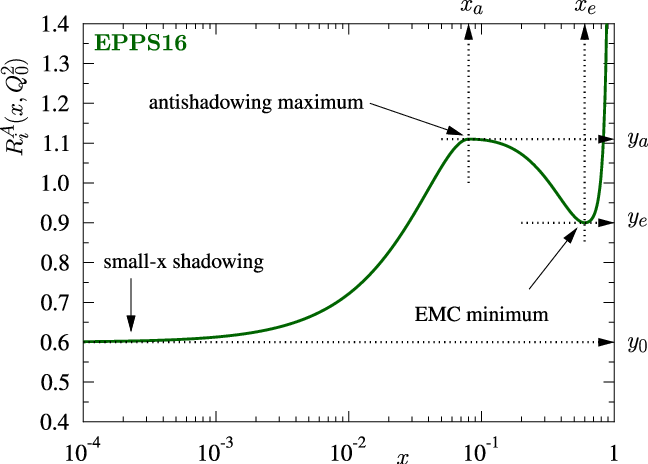
The determination of nuclear parton distribution functions (nPDFs) is essential for understanding how the quark and gluon structure of nucleons is modified within nuclei and for providing precise theoretical predictions for high-energy nuclear collisions. Members of the French EIC community have made significant contributions to the phenomenology and global extraction of nPDFs, combining a wide range of experimental data with state-of-the-art QCD analyses to constrain nuclear effects across broad kinematic regimes. Complementary research efforts focus on the propagation of energetic partons through cold nuclear matter and on the mechanisms responsible for parton energy loss, which are key ingredients in the interpretation of hard processes involving nuclei. The future Electron-Ion Collider will dramatically extend the kinematic reach of current measurements, providing unprecedented sensitivity to the gluon content of nuclei and to the dynamics of parton propagation in nuclear matter, thereby opening a new era of precision studies of QCD in the nuclear environment.
- Nuclear cold QCD: Review and future strategy, Phys.Rev.D 111 (2025) 9, 094021, arXiv:2506.17454
- Modification of Quark-Gluon Distributions in Nuclei by Correlated Nucleon Pairs, Phys.Rev.Lett. 133 (2024) 15, 152502, arXiv:2312.16293
Gluon saturation in nuclei
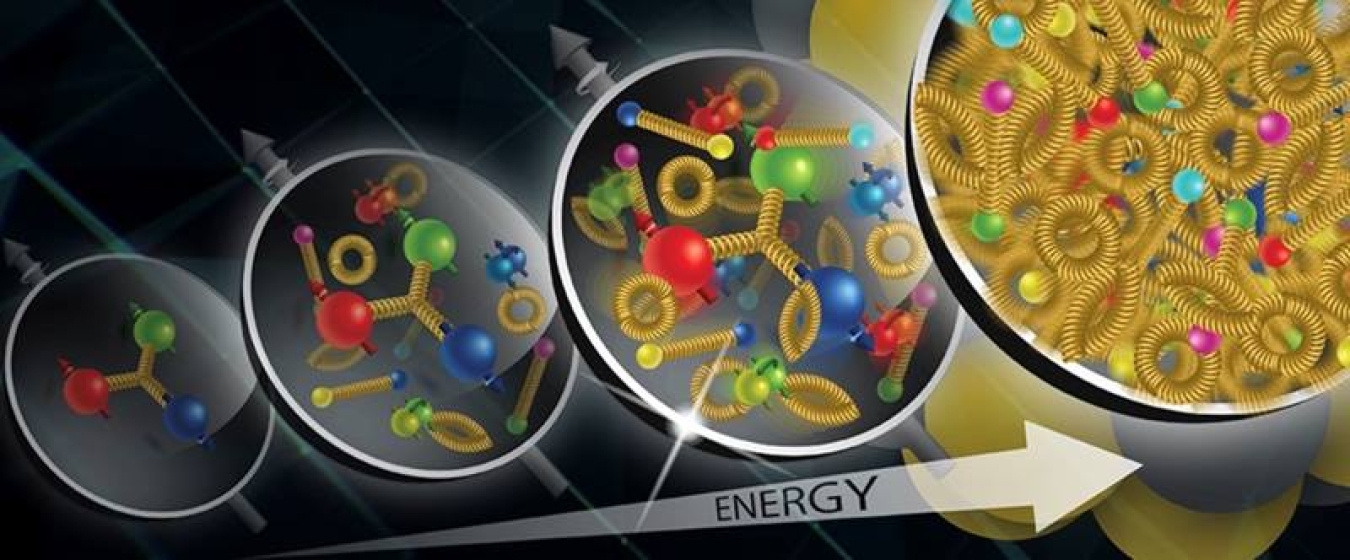
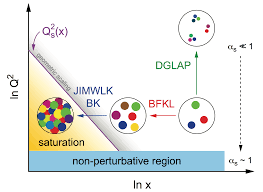
The gluon density inside nucleons and nuclei increases with energy, but this growth eventually saturates due to gluon recombination effects. This gluon saturation phenomenon is actively studied by the French community working on the Electron-Ion Collider, with the aim of improving the theoretical framework through higher-order QCD corrections and identifying robust observables that could experimentally reveal its main features at the Large Hadron Collider and the future EIC.
Phenomenology of gluon saturation
In preparation for the Electron-Ion Collider, it is essential to identify and develop observables that are sensitive to the nonlinear effects associated with gluon saturation in nuclei, both in inclusive and diffractive processes. The French community’s strong involvement in forward physics and ultra-peripheral collisions at the Large Hadron Collider provides a significant advantage in this effort. It fosters valuable synergies and complementarity between searches for gluon-saturation signatures in proton–nucleus and electron–nucleus collisions, thereby strengthening the broader experimental and theoretical program aimed at uncovering the high-density regime of Quantum Chromodynamics.
- Unveiling the sea: universality of the transverse momentum dependent quark distributions at small x, Phys.Lett.B 874 (2026) 140271, arXiv:2503.16162
- Small-x Factorization in the Target Fragmentation Region, Phys.Rev.Lett. 136 (2026) 8, 081901, arXiv:2502.02634
- Probing Gluonic Saturation in Deeply Virtual Meson Production beyond Leading Power, Phys.Rev.Lett. 134 (2025) 4, 041901, arXiv:2407.18203
- TMD factorisation for diffractive jets in photon-nucleus interactions, JHEP 06 (2024) 180, arXiv:2402.14748
Precision studies of the Color Glass Condensate
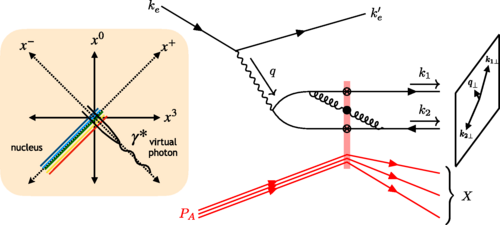
For several key observables, regarded as benchmark probes of gluon saturation, achieving the highest possible level of precision within perturbative Quantum Chromodynamics is essential. Such precision is required to robustly extract the saturation scale, as well as its dependence on Bjorken-x and the nuclear mass number, from future EIC data. This constitutes another active area of research within the EIC-France community. Effective field theory techniques based on the Color Glass Condensate framework provide a systematic approach for carrying out these high-precision calculations and for connecting theoretical predictions to experimental measurements.
- Gluon splitting at small x: a unified derivation for the JIMWLK, DGLAP and CSS equations, JHEP 03 (2026) 198, arXiv:2510.08454
- SIDIS at small x at next-to-leading order: Transverse photon, Phys.Rev.D 112 (2025) 5, 054020, arXiv:2505.04557